
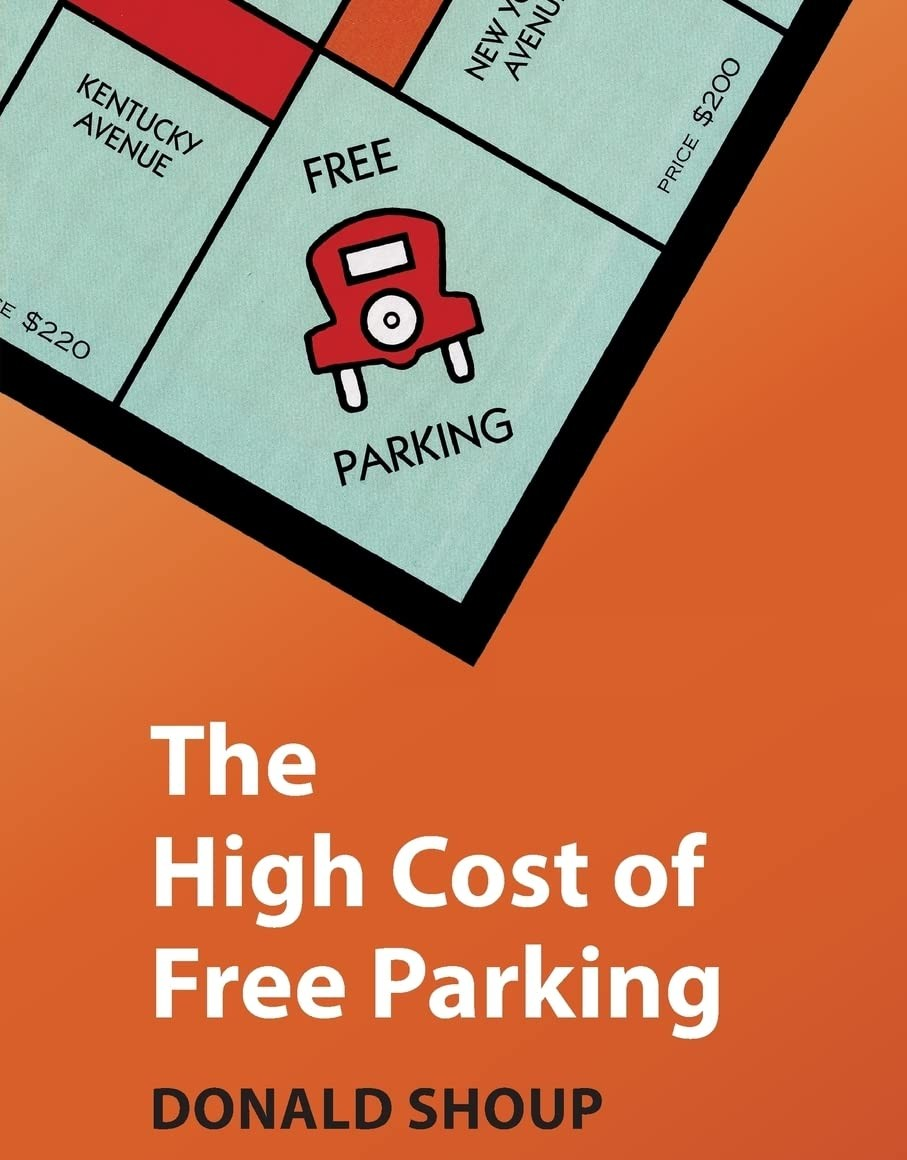
This year marks twenty years since UCLA Urban Planning Professor Donald Shoup released his influential book, The High Cost of Free Parking, and, with his recent passing, it’s a good time to examine how his book lives on. Shoup made waves by declaring free curb parking as a “commons” problem—one where private use of public space deprives others of its benefits. His framing of how cities do, can, and should handle parking serves as a case study for broader discussions on municipal capacity.
In the years since, Shoup’s following, known as Shoupistas, have embraced a movement that goes beyond just charging for parking.
Parking may seem too small an issue to merit such a lengthy book and dedicated following. So why is parking so compelling as a policy problem?
One theory is because parking is so understandable. Some see it as bike-shedding. Every city faces it somewhere, policy changes are visible and often tangible, and the political stakes are relatively low. Groups across the political spectrum can project their agendas onto an issue as visible as parking. Environmentalists, libertarians, neighborhood business owners, the bicycle coalition, and parents all have perspectives on how parking ought to be improved. Most drivers have some intuition about whether downtown parking is scarce; fewer have something to say about the state of local pension plans.
Another, less-cited theory: parking is uniquely data-rich. Since the book’s publication, cities have installed sensors, smart meters, and even aerial cameras, each feeding back data. Numbers on parking occupancy, traffic patterns and average time to park (cruising), and revenues, all help provide a measurable feedback loop for policy decisions. The rise of mid-2010s smart cities brought an explosion of data to policymaking in the 2010s.
The implication from theory #2 is interesting. Successful cities built operational infrastructure to improve parking: feedback loops, iteration systems, and the data platforms that let officials test and tweak policies. Rather than relying on getting everything right the first time or depending on future political groundswells to continue pushing forward change, the key unlock has been the information layer.
The High Cost of Free Parking is exhaustive, featuring detailed drilldowns into hypothetical parker cost-benefit calculations. I read it through recently, having only read a spot chapter or two in college several years ago. In the wake of Shoup’s passing, I wanted to assess how cities have acted on his recommendations.
To summarize, Shoup proposed three major reforms:
- Apply performance-based pricing in cities to ensure there are 1-2 open parking spaces per block at peak hours.
- Return meter revenue toward local streetscape and neighborhood improvements, through “Parking Benefit Districts.”
- Reduce or remove minimum parking requirements where possible.
Performance-based pricing
Let’s look at San Francisco and Seattle’s updates to parking policy in recent years. Both cities implemented a dynamic pricing system aimed at controlling curb occupancy rates. San Francisco piloted its SFpark program in 2011 using federal funds, installing sensors and smart meters to adjust meter rates block-by-block based on real-time demand. The city further utilized the data by providing an SFpark mobile app, which published real-time spot availability. City data showed cruising times went down, parking availability increased on balance, and the average meter rate decreased by $0.11/hour during the pilot.1 Buoyed by this pilot’s success, SF expanded demand-based pricing citywide in 2018.
Seattle adopted a similar approach, introducing a Performance-Based Pricing Program in 2010 to reach its stated goal of “one to two spaces open and available on each blockface throughout the day.”2 The city now keeps parking occupancy data in about 30 business districts to keep pricing responsive to local fluctuations in demand, and the data is released in annual reports. Mirroring the surprise in San Francisco, public skepticism among Seattleites eased when rates decreased in as many areas as they increased.
Parking Benefit Districts
In addition, Seattle approved a pilot Parking Benefit District in the Capitol Hill neighborhood, using meter revenues to fund improvements to the streetscape. The Capitol Hill EcoDistrict pilot was designed to fund local projects in Capitol Hill, such as bike infrastructure and transit subsidies. Shoup wrote that earmarking revenues for local projects may prove politically difficult. Seattle officials, encountering political headwinds, made the consequential decision to keep most of the meter revenue for the city general fund, invoking equity concerns that keeping meter revenue local would disadvantage some neighborhoods. The revenue returned to the Seattle Department of Transportation’s General Fund, which pays for maintenance and transportion infrastructure across all neighborhoods of the city. While the Capitol Hill EcoDistrict remains to this day, the PBD pilot has not scaled citywide, perhaps due to a lack of public support and other pressing transit priorities such as the significantly delayed light rail 2 Line extension.3 Seattle broke the Shoupian political bargain of PBDs by only partially reinvesting in Capitol Hill.
Similarly, San Francisco’s use of parking meter revenue has not changed significantly since the publishing of The High Cost of Free Parking. By city charter, parking revenue goes to the city’s transportation fund, rather than a general fund. The city has considered more localized PBDs, but amending the city charter would be required and political support is so far insufficient. As a result of the city’s decision not to fund PBDs, neighborhoods have been hostile to city efforts to expand metered parking. For example, plans to meter the Dogpatch neighborhood’s parking were met with resistance from residents, with many skeptical of the city’s claim the meter expansion was an effort to improve traffic rather than raise money.
Mandatory Parking Minimums
Seattle has rolled back parking minimums aggressively since 2012. Within five years, city policies led to an 18,000-unit reduction in parking – over 30% fewer spots being built. One study estimated the reduction in aggregate construction costs at $537 million—a benefit passed on to residents in the form of lower rents.3 More recently, Seattle has eliminated parking minimums anywhere where transit access is adequate, and ongoing bus rapid transit (BRT) and light rail improvements are further decoupling parking from new construction.
The Road Ahead
Both San Francisco and Seattle have made strides to improve the parking experience, but work remains to fulfill the vision of Shoup. The common thread tying the successes in SF and Seattle is procedure: the policies that build in evaluation-and-adjustment mechanisms have lived on. San Francisco used federal money for pilots and incremental expansions, while Seattle took on the performance pricing and aggressive, data-backed zoning reform. Where the cities faltered, they failed to earn a mandate from the public for further changes.
One way these cities can continue pushing forward parking reform is by surfacing simple neighborhood improvements back to residents. Even if state and local statutory constraints complicated formal PBDs, cities can find ways to earmark the money for streetscape improvements and smaller projects with a higher chance of conveying than expensive projects such as light rail construction that draw from the general transportation fund. Investing in local “easy wins,” such as street trees, lighting, and painted crosswalks, could have both a visual and tangible political benefit.
To me, Shoup’s words on parking look like the start of a classic proof by induction. If a city can build a system that measures, iterates, and mitigates a small problem, such as parking, then it can copy the playbook to bigger problems. That template is how cities build the capacity to earn wins on housing, transit, and beyond.
References